

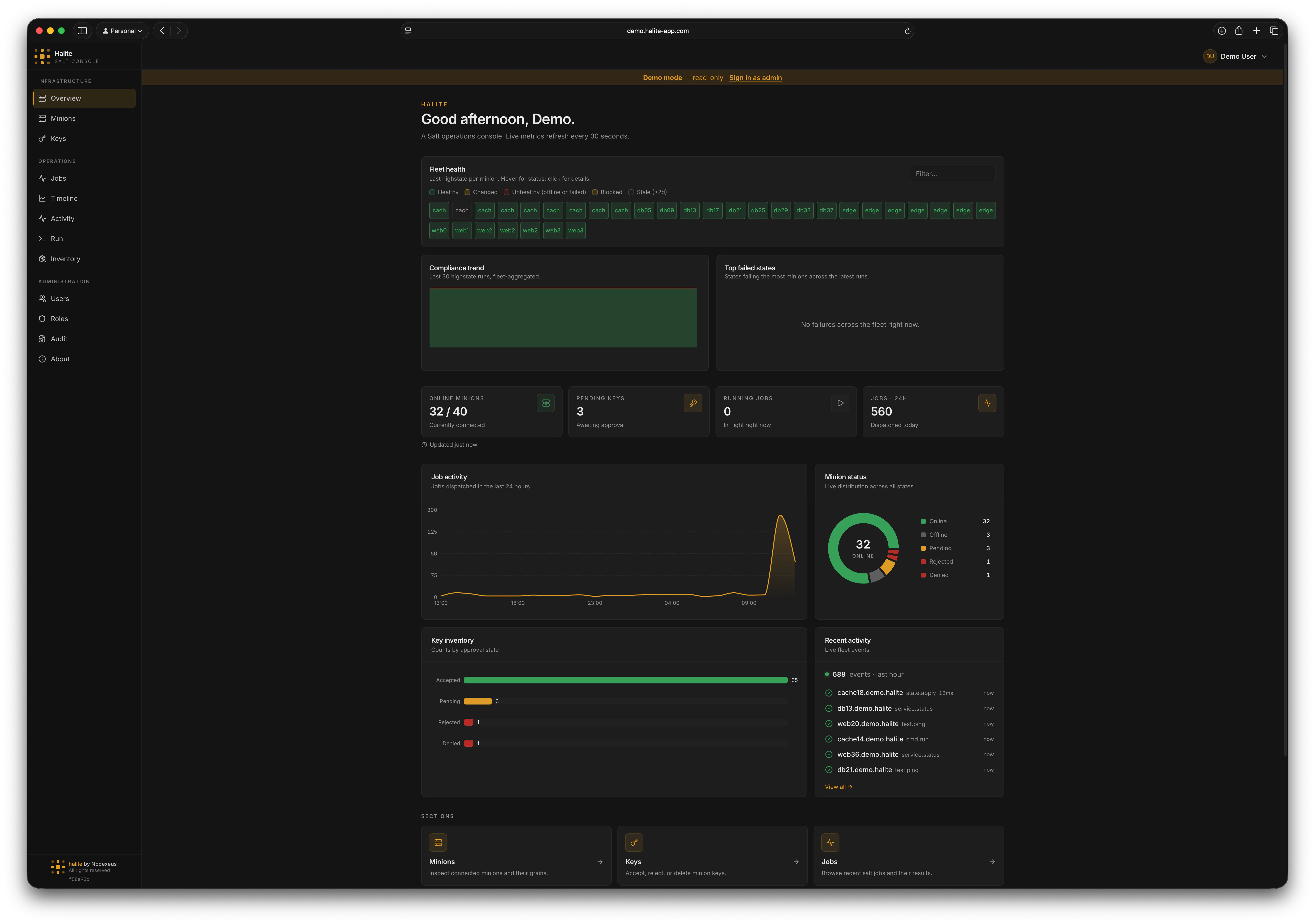
Halite Overview dashboard showing KPI tiles and activity charts
KPI tiles
The four stat cards at the top of the page answer the most common operational questions at a glance: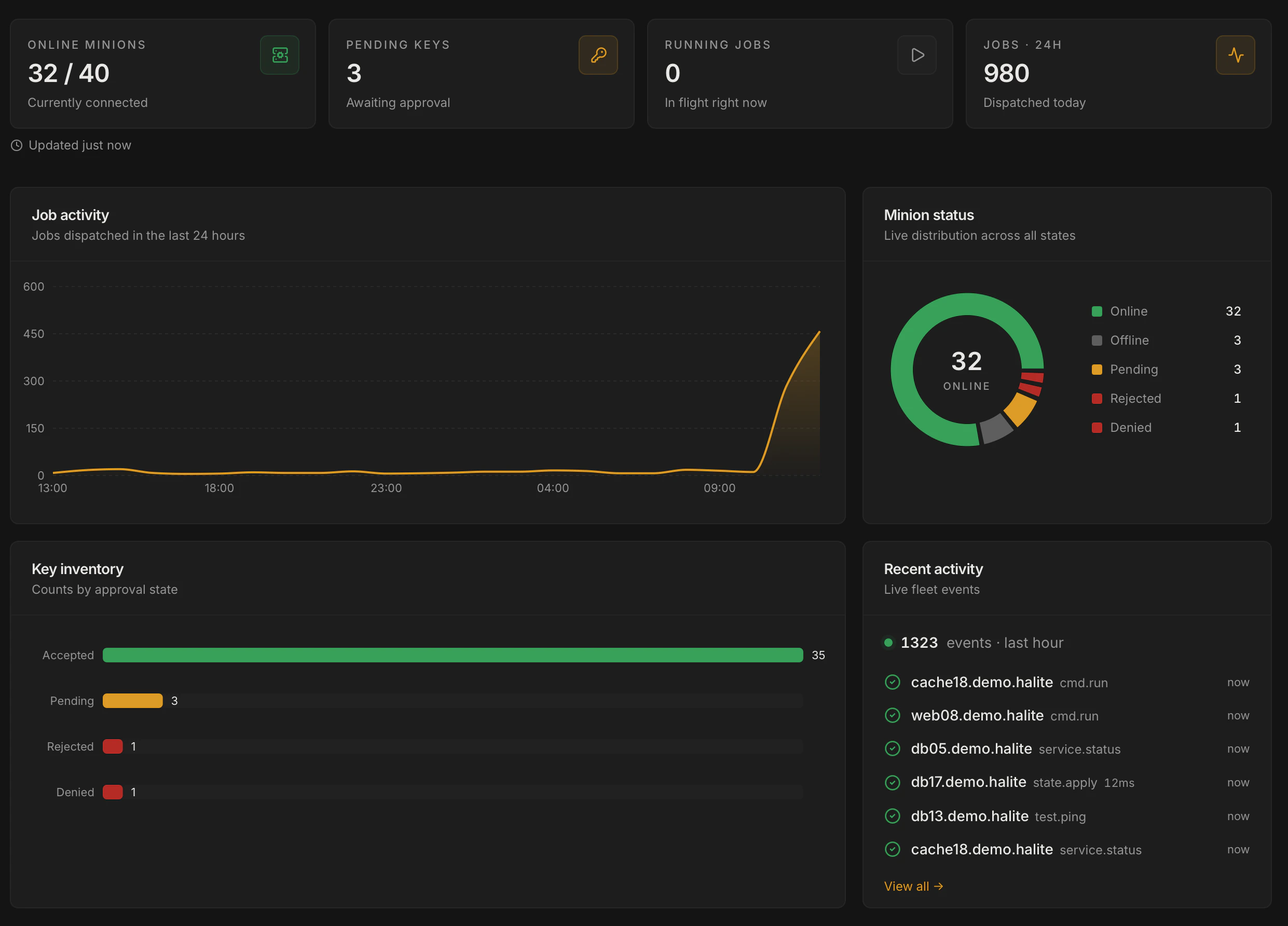
KPI tiles showing online minions, pending keys, running jobs, and 24h job count
The KPI tiles render a dash (
—) for any metric your role does not have permission to view. The tiles are independent — having view:job:* but not view:key:* is valid.Activity charts
Below the KPI row, three charts give you a time-series and distribution picture of fleet activity:Job activity area chart
A 24-hour area chart of jobs dispatched per hour, built from thejobs_index database table. The server buckets the data by hour before sending it to the browser, so the chart scales past whatever the in-memory job-cache can hold. The active_known flag lets the UI warn you when the background scheduler has not yet ticked.
Minion-status donut
A donut chart breaking down all known minions by their status: online, offline, pending, rejected, or denied. Data comes from the same minion snapshot table used by the Minions page.Key-status bar chart
A bar chart grouping all keys by their approval state (accepted, pending, rejected, denied). This gives you an inventory-level view of fleet onboarding health. The data is served live from the Salt master via the same/api/keys endpoint used by the Keys page.
Recent activity
When the event stream is enabled, the Overview includes a Recent activity widget — a compact, live-updating list of the latest fleet events (jobs, keys, minions) that links through to the full Activity page. At the top of the widget, a heartbeat indicator with a pulsing dot shows how many events arrived in a recent window (for example, “12 events · last 60 min”). It is a quick pulse-check that the fleet — and the event stream — is alive. An admin tunes the widget from Settings → Activity widget: which categories it shows, whether to hide dispatches or routine successes, how many events to list, and the heartbeat window. Those display settings are read by every user viaGET /api/activity/widget-config; the underlying events are still filtered to the categories your role can view.
Fleet heatmap and compliance sparkline
Above the KPI row, the fleet heatmap shows every minion as a tile, colour-coded by online/offline status; clicking a tile opens a side panel where you can run a command directly against that minion. Below it, the compliance sparkline and top-failures chart surface recent highstate trends.Navigation tiles
At the bottom of the page, a grid of section tiles links to every major feature. Tiles your role cannot access are hidden automatically — you only see what you have permission to use.Permissions
The Overview page assembles data from multiple endpoints. Each section is gated by the permission of its underlying endpoint:
Any authenticated session can load the page shell; the tiles and charts that you lack permissions for render a graceful empty state rather than an error.