> ## Documentation Index
> Fetch the complete documentation index at: https://www.halite-app.com/llms.txt
> Use this file to discover all available pages before exploring further.
# Inventory
> Package inventory across the fleet.
The Inventory page gives you a searchable, filterable view of every installed package across your Salt fleet. Data is collected from minions via `pkg.list_pkgs` and stored locally, so browsing the fleet's packages does not require a live Salt connection.
The page is organised as a three-level drill-down:
1. **Fleet-wide aggregate** — one row per package name, with how many minions have it and how many distinct versions exist.
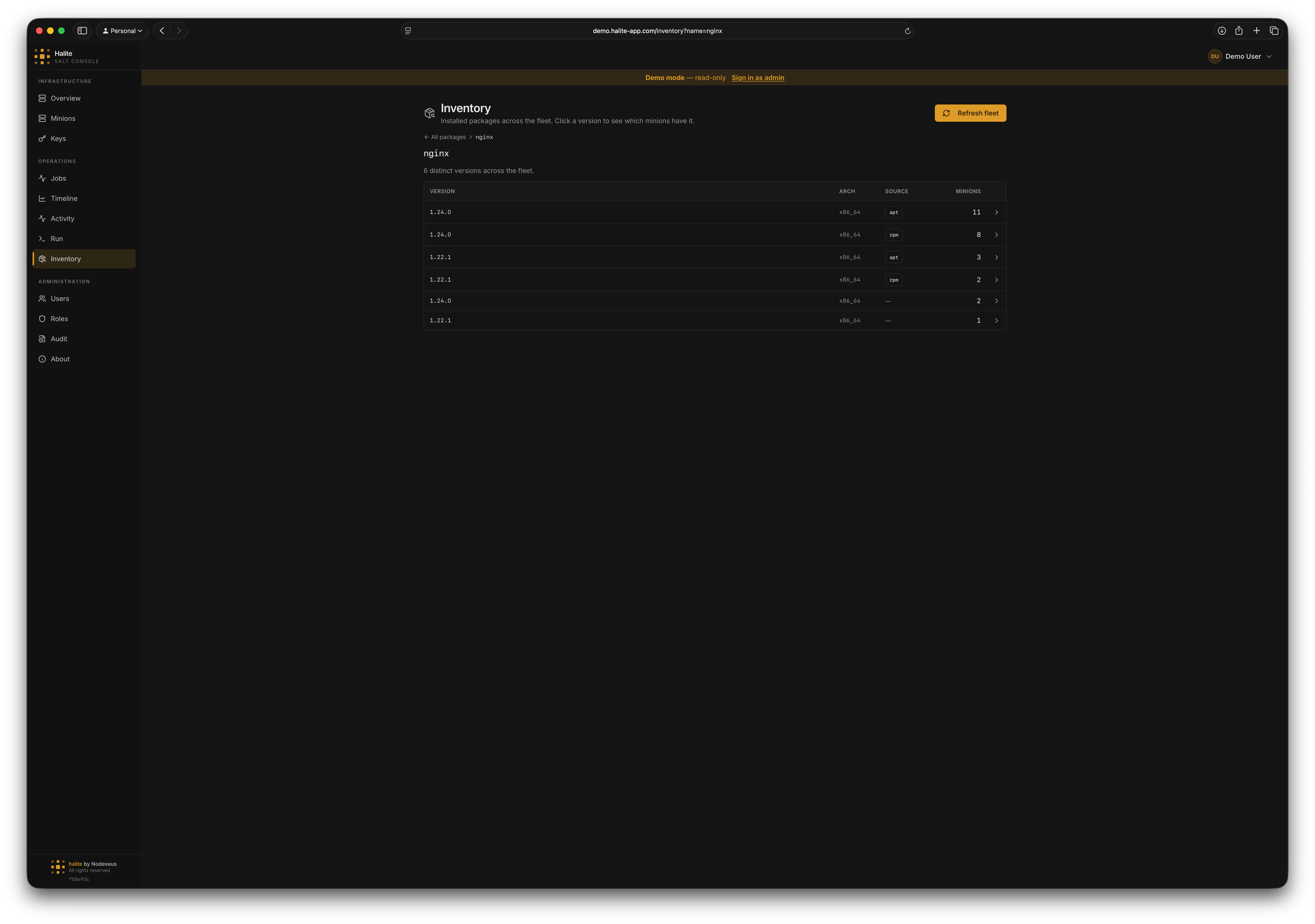
2. **Version list** — click a package name to see every distinct `(version, arch, source)` combination and a count of minions on each.
3. **Row-level search** — use the advanced query endpoint to find all minions where a specific package version satisfies a comparison (`=`, `≠`, `<`, `≤`, `>`, `≥`).
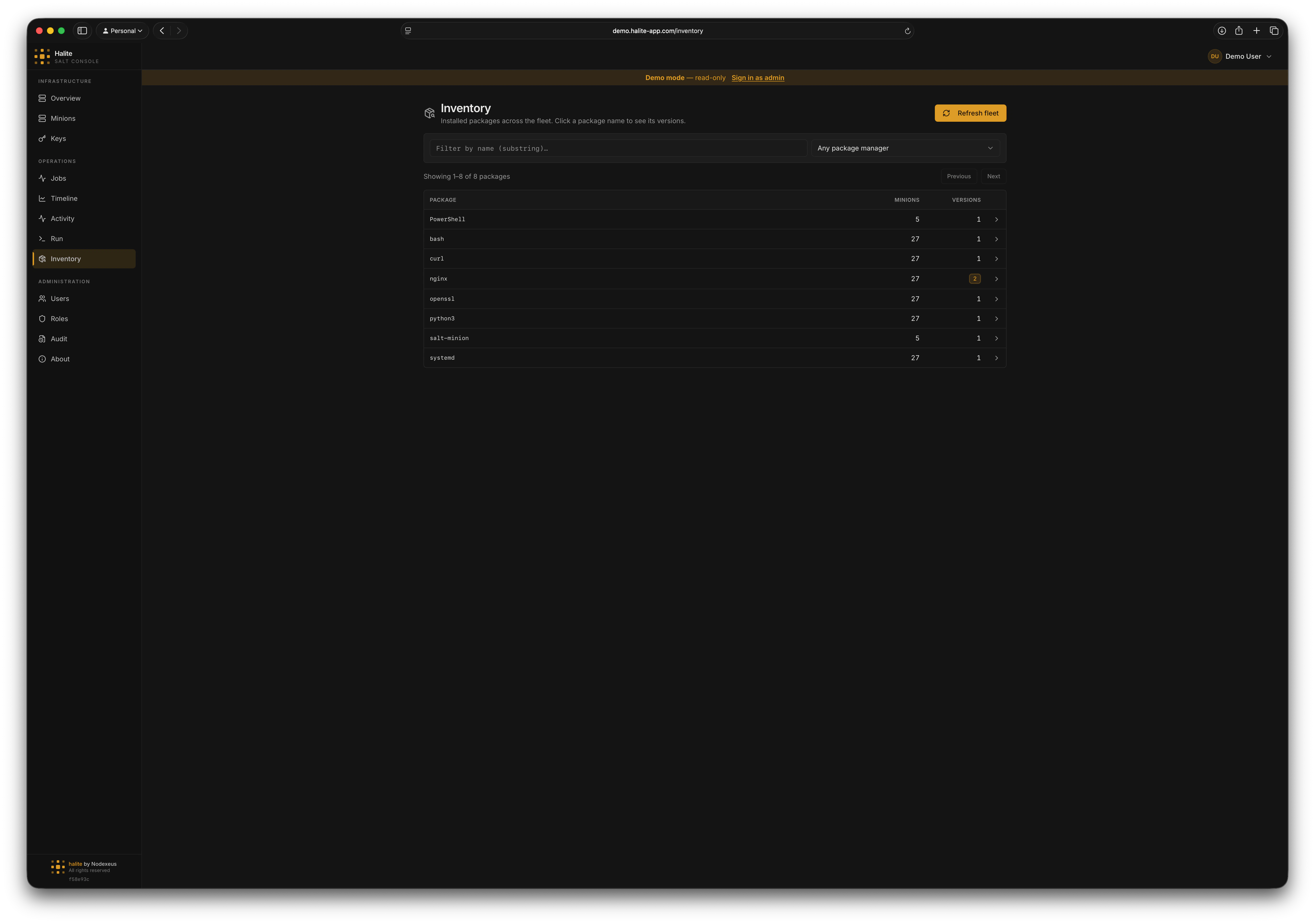 ## Level 1 — fleet-wide package list
The default landing view calls `GET /api/inventory/packages`. It groups every `inventory_package` row by name and returns:
| Field | Description |
| --------------- | ------------------------------------------------------------------ |
| `name` | Package name |
| `minion_count` | Number of distinct minions that have this package installed |
| `version_count` | Number of distinct versions seen across the fleet |
| `last_seen` | Timestamp of the most recent collection that included this package |
Use the `q` query parameter for a case-insensitive substring search on package name. Optionally narrow by `source` (`apt`, `rpm`, or `pacman`). Results are paginated via `limit` (1–5000, default 100) and `offset`.
## Level 2 — per-package version list
Click a package row to call `GET /api/inventory/packages/{name}/versions`. The response contains one row per distinct `(version, arch, source)` combination, sorted by `minion_count` descending so the most-deployed version appears first.
## Level 1 — fleet-wide package list
The default landing view calls `GET /api/inventory/packages`. It groups every `inventory_package` row by name and returns:
| Field | Description |
| --------------- | ------------------------------------------------------------------ |
| `name` | Package name |
| `minion_count` | Number of distinct minions that have this package installed |
| `version_count` | Number of distinct versions seen across the fleet |
| `last_seen` | Timestamp of the most recent collection that included this package |
Use the `q` query parameter for a case-insensitive substring search on package name. Optionally narrow by `source` (`apt`, `rpm`, or `pacman`). Results are paginated via `limit` (1–5000, default 100) and `offset`.
## Level 2 — per-package version list
Click a package row to call `GET /api/inventory/packages/{name}/versions`. The response contains one row per distinct `(version, arch, source)` combination, sorted by `minion_count` descending so the most-deployed version appears first.
 ## Level 3 — row-level search
`POST /api/inventory/packages/search` accepts a structured filter body (`PackageQueryIn`):
| Field | Type | Description |
| ----------- | ------------- | ------------------------------------------------------------------------------- |
| `name` | `{op, value}` | Name filter: `op` is `"eq"`, `"prefix"`, or `"contains"` |
| `version` | `{op, value}` | Version comparison: `op` is `"eq"`, `"ne"`, `"lt"`, `"lte"`, `"gt"`, or `"gte"` |
| `source` | string | One of `"apt"`, `"rpm"`, `"pacman"` |
| `minion_id` | string | Filter to a single minion |
| `limit` | int | 1–5000, default 500 |
| `offset` | int | Default 0 |
At least one of `name` or `minion_id` is required.
### Version comparison
Version strings are compared using package-manager-aware logic — `"10.0"` correctly sorts as greater than `"2.0"`. The dispatcher is chosen based on the `source` column:
| Source | Comparison rules |
| -------------------------------- | ------------------------------------------------------------------------------------------------------------ |
| `apt` / `deb` / `dpkg` | Debian `deb-version(5)` spec — epoch, upstream, Debian revision, tilde pre-release |
| `rpm` / `dnf` / `yum` / `zypper` | RPM spec — epoch, version, release, digit vs. letter run ordering |
| `pacman` / `arch` | Arch `vercmp` rules (close to RPM) |
| unknown / `null` | Generic comparator — splits on `.`, `-`, `_`, `+` and compares runs numerically when both sides are integers |
The `truncated` flag in the response is `true` when the SQL candidate set was capped at 50,000 rows before the version filter ran; in that case, narrow your name or minion filter.
## Refreshing inventory data
### Manual refresh
Click **Refresh** in the Inventory UI (or `POST /api/inventory/refresh`). The request body is:
```json theme={"dark"}
{
"target": "*",
"target_type": "glob"
}
```
Supported `target_type` values: `glob`, `list`, `pcre`, `grain`, `nodegroup`, `compound`.
The endpoint fans out `pkg.list_pkgs` and `grains.get os_family` to the targeted minions simultaneously, then does a delete-and-reinsert for each minion's rows in a single transaction. If no minions respond with usable data, the API returns `502 Bad Gateway`.
### Background scheduler
Halite can refresh inventory automatically. The interval is configured in-app (not via env vars) under **Settings → Pollers**. The relevant field is `inventory_refresh_minutes` — set it to `0` to disable the scheduler. You can also set `inventory_refresh_initial_delay_s` to control how long after startup the first run waits (default: 30 s).
The scheduler fires one iteration, waits for it to complete, then sleeps the full interval before the next iteration. A slow refresh does not queue additional refreshes. Offline minions are silently skipped and retain their previous snapshot.
See [Settings](/features/settings) for the full list of configurable intervals.
## Example: finding servers with an outdated OpenSSL
On the Inventory page, type `openssl` in the search box. The fleet-wide aggregate shows all matching packages and how many minions are on each version.
Click `openssl` to view the version list. The dominant (most-deployed) version appears first.
Switch to the advanced query form and set a version filter of `< 3.0.0` with `source = apt`. The results show every minion still running OpenSSL below 3.0.0, ready to target with a package upgrade job.
## Permissions
| Route | Required permission |
| --------------------------------------------- | --------------------- |
| `GET /api/inventory/packages` | `view:inventory:*` |
| `GET /api/inventory/packages/{name}/versions` | `view:inventory:*` |
| `POST /api/inventory/packages/search` | `view:inventory:*` |
| `POST /api/inventory/refresh` | `collect:inventory:*` |
The built-in **viewer** role includes `view:inventory:*` (read-only access). Triggering a manual refresh requires `collect:inventory:*`, which is not granted to viewer — assign the **operator** role or create a custom role to allow it.
## Level 3 — row-level search
`POST /api/inventory/packages/search` accepts a structured filter body (`PackageQueryIn`):
| Field | Type | Description |
| ----------- | ------------- | ------------------------------------------------------------------------------- |
| `name` | `{op, value}` | Name filter: `op` is `"eq"`, `"prefix"`, or `"contains"` |
| `version` | `{op, value}` | Version comparison: `op` is `"eq"`, `"ne"`, `"lt"`, `"lte"`, `"gt"`, or `"gte"` |
| `source` | string | One of `"apt"`, `"rpm"`, `"pacman"` |
| `minion_id` | string | Filter to a single minion |
| `limit` | int | 1–5000, default 500 |
| `offset` | int | Default 0 |
At least one of `name` or `minion_id` is required.
### Version comparison
Version strings are compared using package-manager-aware logic — `"10.0"` correctly sorts as greater than `"2.0"`. The dispatcher is chosen based on the `source` column:
| Source | Comparison rules |
| -------------------------------- | ------------------------------------------------------------------------------------------------------------ |
| `apt` / `deb` / `dpkg` | Debian `deb-version(5)` spec — epoch, upstream, Debian revision, tilde pre-release |
| `rpm` / `dnf` / `yum` / `zypper` | RPM spec — epoch, version, release, digit vs. letter run ordering |
| `pacman` / `arch` | Arch `vercmp` rules (close to RPM) |
| unknown / `null` | Generic comparator — splits on `.`, `-`, `_`, `+` and compares runs numerically when both sides are integers |
The `truncated` flag in the response is `true` when the SQL candidate set was capped at 50,000 rows before the version filter ran; in that case, narrow your name or minion filter.
## Refreshing inventory data
### Manual refresh
Click **Refresh** in the Inventory UI (or `POST /api/inventory/refresh`). The request body is:
```json theme={"dark"}
{
"target": "*",
"target_type": "glob"
}
```
Supported `target_type` values: `glob`, `list`, `pcre`, `grain`, `nodegroup`, `compound`.
The endpoint fans out `pkg.list_pkgs` and `grains.get os_family` to the targeted minions simultaneously, then does a delete-and-reinsert for each minion's rows in a single transaction. If no minions respond with usable data, the API returns `502 Bad Gateway`.
### Background scheduler
Halite can refresh inventory automatically. The interval is configured in-app (not via env vars) under **Settings → Pollers**. The relevant field is `inventory_refresh_minutes` — set it to `0` to disable the scheduler. You can also set `inventory_refresh_initial_delay_s` to control how long after startup the first run waits (default: 30 s).
The scheduler fires one iteration, waits for it to complete, then sleeps the full interval before the next iteration. A slow refresh does not queue additional refreshes. Offline minions are silently skipped and retain their previous snapshot.
See [Settings](/features/settings) for the full list of configurable intervals.
## Example: finding servers with an outdated OpenSSL
On the Inventory page, type `openssl` in the search box. The fleet-wide aggregate shows all matching packages and how many minions are on each version.
Click `openssl` to view the version list. The dominant (most-deployed) version appears first.
Switch to the advanced query form and set a version filter of `< 3.0.0` with `source = apt`. The results show every minion still running OpenSSL below 3.0.0, ready to target with a package upgrade job.
## Permissions
| Route | Required permission |
| --------------------------------------------- | --------------------- |
| `GET /api/inventory/packages` | `view:inventory:*` |
| `GET /api/inventory/packages/{name}/versions` | `view:inventory:*` |
| `POST /api/inventory/packages/search` | `view:inventory:*` |
| `POST /api/inventory/refresh` | `collect:inventory:*` |
The built-in **viewer** role includes `view:inventory:*` (read-only access). Triggering a manual refresh requires `collect:inventory:*`, which is not granted to viewer — assign the **operator** role or create a custom role to allow it.